
What is OPEC? How the Oil Cartel Functions and Why It’s Fracturing in 2026
- The Definition: The Organization of the Petroleum Exporting Countries (OPEC) is a multinational cartel designed to coordinate petroleum policies and stabilize oil markets.
- The Mechanism: OPEC influences global oil prices by adjusting the collective oil production output of its member countries. They restrict supply to raise prices or increase supply to lower them.
- The 2026 Reality: The traditional OPEC model is currently facing an existential crisis. The inherent flaw of the cartel—differing national budget requirements—has pushed major producers to rebel against strict production limits.
Every time you pay for gas, buy an airline ticket, or purchase food transported by truck, your wallet is being influenced by decisions made thousands of miles away in a boardroom in Vienna.
That boardroom belongs to OPEC.
For over six decades, this organization has held unprecedented leverage over the global economy. But understanding OPEC requires looking past the basic definition of an “oil alliance.” It is a complex, often fragile cartel of competing sovereign interests. Here is the complete explainer on what OPEC is, how it dictates global markets, and the hidden mechanics of why the organization is currently unraveling.
What is OPEC? (The Architecture)
Founded in Baghdad in 1960 by Iran, Iraq, Kuwait, Saudi Arabia, and Venezuela, OPEC was created to counter the dominance of Western oil companies (known as the “Seven Sisters”) that were unilaterally lowering crude prices.
By banding together, these resource-rich nations took back control of their own sovereign wealth.
Today, OPEC is headquartered in Vienna, Austria (which is ironically not a member state). While membership fluctuates, the core objective remains the same: to secure a steady income for producing nations and a regular supply for consuming nations.
The Evolution to OPEC+
In 2016, realizing that the booming United States shale oil industry was undermining their market share, OPEC partnered with 10 non-OPEC oil-producing nations, most notably Russia. This expanded super-cartel became known as OPEC+, controlling roughly 40% of global oil production and over 80% of proven reserves.
How OPEC Functions: The Power of the Tap
OPEC does not directly set the price of oil. Instead, it manipulates the foundational rule of economics: supply and demand.
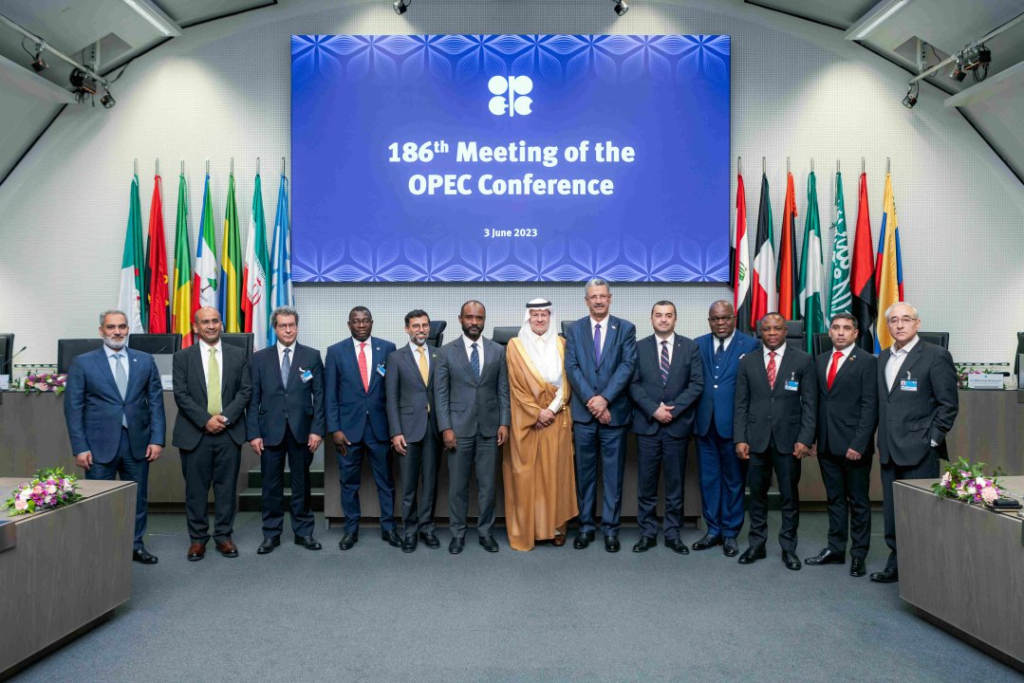
The organization functions through a quota system. During their regular meetings, member states analyze global economic forecasts, inventory levels, and geopolitical risks. Based on this data, they agree on an overall production ceiling and assign specific daily pumping limits (quotas) to each member.
- To Raise Prices: If the global economy is slowing down and demand is dropping, OPEC will vote to cut production. By artificially restricting the supply of oil entering the market, buyers must compete for fewer barrels, driving the price up.
- To Lower Prices: If prices spike too high—which risks pushing importing nations into recession and destroying long-term oil demand—OPEC will vote to increase production, flooding the market and cooling prices down.
Saudi Arabia, as the largest producer and the “de facto” leader of the group, acts as the “swing producer.” It frequently absorbs the largest production cuts to keep the cartel balanced.
The Geopolitical Impact: Weaponizing the Market
OPEC’s decisions ripple through every corner of the global economy.
When OPEC restricts supply and oil prices surge, the impact is highly inflationary. The cost of manufacturing, shipping, and agriculture all spike. This forces central banks in the U.S. and Europe to keep interest rates high, which slows down global economic growth.
Conversely, OPEC has occasionally used its massive production capacity as a geopolitical weapon. In 2014, rather than cutting production to boost prices, OPEC flooded the market with cheap crude. The objective was to drive prices so low that the expensive, newly established U.S. shale oil companies would go bankrupt.
The “Fiscal Break-Even” Paradox
If you search for basic explainers on OPEC, most will describe it as a unified bloc working together to maximize profits. That is a facade.
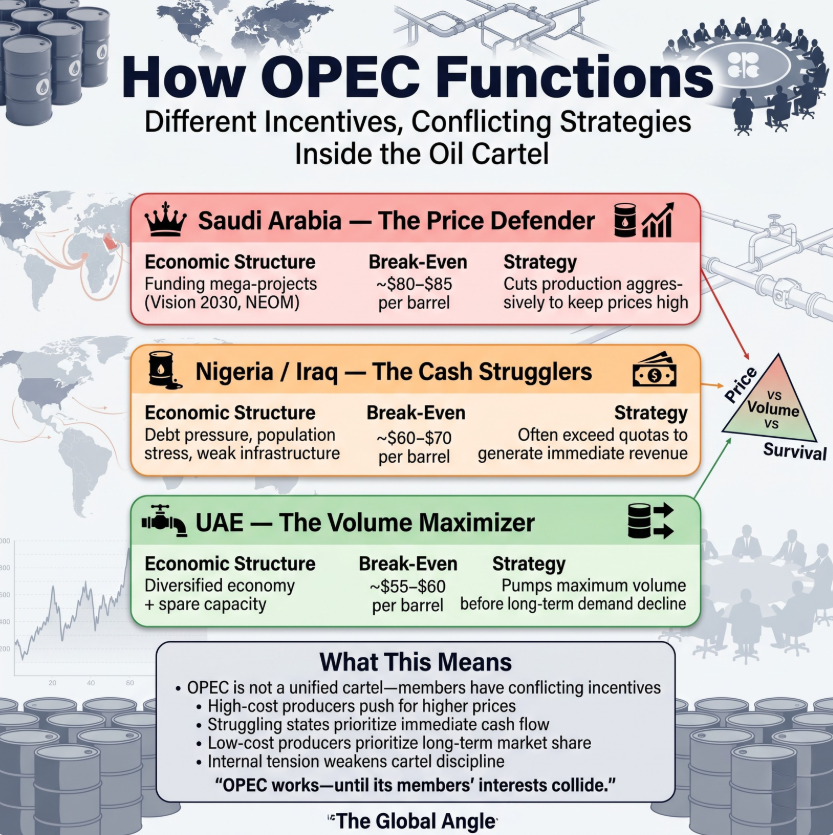
The most important, least discussed metric in understanding how OPEC actually works is the Fiscal Break-Even Price. This is the specific price per barrel of oil a country needs to balance its national government budget.
How OPEC Functions
| Nation | Economic Structure | Estimated Break-Even Need | Cartel Behavior |
| Saudi Arabia | Funding trillion-dollar “Vision 2030” mega-projects (e.g., Neom). | ~$80 – $85 / barrel | Demands aggressive production cuts to keep prices artificially high. |
| Nigeria / Iraq | Struggling with domestic debt, high populations, and infrastructure decay. | ~$60 – $70 / barrel | Frequently “cheats” on quotas, secretly pumping more oil than allowed to generate immediate cash flow. |
| The UAE | Highly diversified economy, massive unused production capacity. | ~$55 – $60 / barrel | Rejects deep cuts; wants to pump maximum volume before the global transition to renewable energy. |
The “Cheater’s Dilemma”
Because every nation has a different break-even price, OPEC is trapped in a permanent game of the “Cheater’s Dilemma.”
Saudi Arabia wants to cut production to keep prices at $85. But a smaller nation desperately needs cash today. So, that smaller nation publicly agrees to the cuts, but secretly pumps extra oil onto the black or gray market. When too many countries cheat, the supply restriction fails, prices drop, and Saudi Arabia is forced to either shoulder even deeper cuts alone or start a price war.
The 2026 Fracture
This inherent contradiction is why the cartel is currently fracturing. Nations that have invested billions in expanding their oil infrastructure (like the United Arab Emirates) realize that the era of fossil fuels has an expiration date. If they abide by OPEC quotas, their oil will become a “stranded asset” left in the ground. The modern reality of OPEC is less about unity, and more about a race to monetize reserves before the market structurally shifts toward green energy.
Sources:
International Monetary Fund (IMF) – Regional Economic Outlook: Middle East and Central Asia (Provides the official data on Fiscal Break-Even oil prices required by Middle Eastern nations to balance their national budgets, validating the cartel’s structural flaw)
Center for Strategic and International Studies (CSIS) – Energy Security and Climate Change Program (Deep-dive geopolitical analysis on the “Cheater’s Dilemma,” quota compliance, and the shifting dynamics of OPEC+ in the face of the energy transition)
Organization of the Petroleum Exporting Countries (OPEC) – Monthly Oil Market Reports (MOMR) (Authoritative, primary-source data on production quotas, compliance rates, and the baseline supply/demand metrics used by the cartel)
Oxford Institute for Energy Studies – The Future of OPEC and Stranded Assets (Academic and market research detailing the long-term timeline and the “stranded asset” fears driving highly-capacitated nations to accelerate production)
Frequently Asked Questions
Does OPEC control the price of gas at the pump?
Not directly, but they are the biggest factor. The price of crude oil accounts for roughly 50% to 60% of what you pay for gasoline. The rest is made up of refining costs, distribution, and local taxes. When OPEC cuts crude production, your gas prices will inevitably rise.
Why doesn’t the United States join OPEC?
The U.S. is currently the world’s largest individual oil producer, largely due to the shale revolution. However, the U.S. oil industry is completely privatized. The federal government does not own the oil and cannot legally force private companies like Exxon or Chevron to abide by international production quotas. Furthermore, joining a price-fixing cartel would violate U.S. antitrust laws.
What is the difference between OPEC and OPEC+?
OPEC is the original 12-member cartel founded in 1960. OPEC+ is a larger alliance formed in 2016 that includes the original OPEC members plus 10 other major oil-producing nations, most notably Russia. OPEC+ was created to regain market control after the U.S. shale boom threatened to make traditional OPEC irrelevant.
ALSO READ: Why the UAE Quit OPEC and the Birth of the Petro-Rupee
ALSO READ: Microsoft OpenAI Partnership Ends: Why Microsoft is Dropping OpenAI’s Exclusive License
Russia China trade relations 2026: Sanctions Evasion, Dual-Use Tech, and the Putin-Xi Summit
Russia China trade relations 2026: Sanctions Evasion, Dual-Use Tech, and the Putin-Xi Summit Executive Briefing…
What is Hantavirus Outbreak 2026: Symptoms, Vaccine Status, and the Climate Vector
What is Hantavirus Outbreak 2026: Symptoms, Vaccine Status, and the Climate Vector The Immediate Trigger:…
Starlink & SpaceX IPO 2026: Everything You Need to Know
Starlink & SpaceX IPO 2026: Everything You Need to Know The Valuation: According to Institutional…
What is OPEC? How the Oil Cartel Functions and Why It’s Fracturing in 2026
What is OPEC? How the Oil Cartel Functions and Why It’s Fracturing in 2026 The…
Why the UAE Quit OPEC and the Birth of the Petro-Rupee
Why the UAE Quit OPEC and the Birth of the Petro-Rupee The Rupture: The United…
Microsoft OpenAI Partnership Ends: Why Microsoft is Dropping OpenAI’s Exclusive License
Microsoft OpenAI Partnership Ends: Why Microsoft is Dropping OpenAI’s Exclusive License The Announcement: On April…

Ibrahim is the Founder and Lead Analyst at The Global Angle, an independent digital platform dedicated to factual geopolitical analysis and international affairs. Based in India, he combines an engineering background with a deep focus on global markets, diplomacy, and strategic security. Ibrahim leverages a data-driven, analytical approach to break down complex international conflicts and economic shifts, helping readers see beyond standard news narratives. When he isn’t researching global policy, he focuses on digital publishing, search engine optimization, and platform architecture.
Pingback: What is Hantavirus Outbreak 2026: Symptoms, Vaccine Status, and the Climate Vector