Key Takeaways
- Iran maintains the largest ballistic missile arsenal in the Middle East, with a primary focus on solid-fuel technology and hypersonic speeds.
- Strategic doctrine shifted toward “Network-Centric Warfare,” prioritizing mass-produced drones over aging conventional airframes.
- The “Axis of Resistance” remains the central pillar of Iran’s forward defense, despite significant regional leadership changes in 2025.
- Evaluating Iran military power capabilities 2026
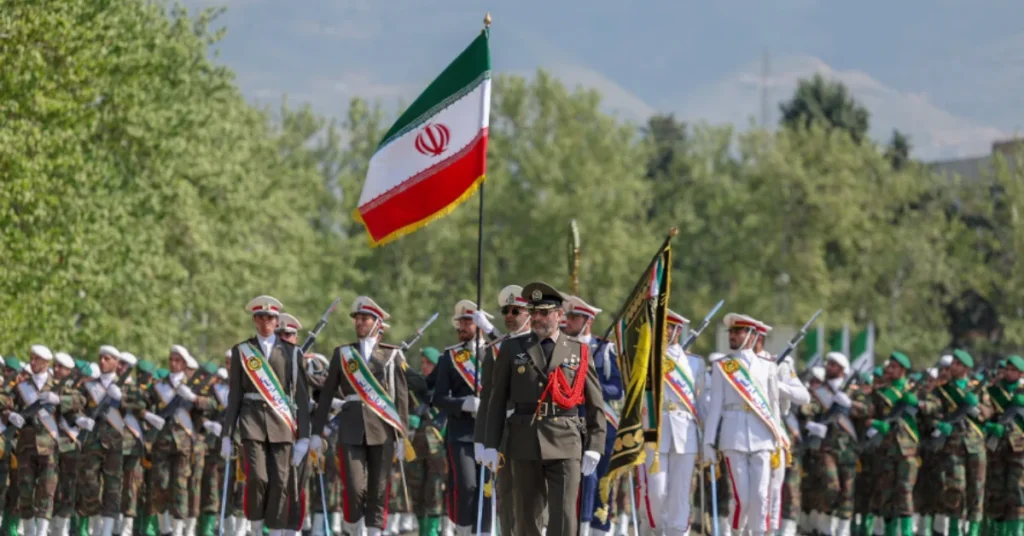
Iran’s military power in 2026 cannot be understood through conventional comparisons alone. While it lacks modern airpower compared to Western forces, it compensates with one of the largest missile arsenals in the region and a highly developed drone warfare strategy.
Recent conflicts have shown that even after sustained strikes, Iran retains significant missile and drone capabilities, highlighting the resilience of its military structure.
According to global military rankings, Iran is among the top 20 military powers worldwide, with a strong focus on manpower and missile capability rather than advanced air force technology.
The Missile Shield: Recent Tests and Capabilities
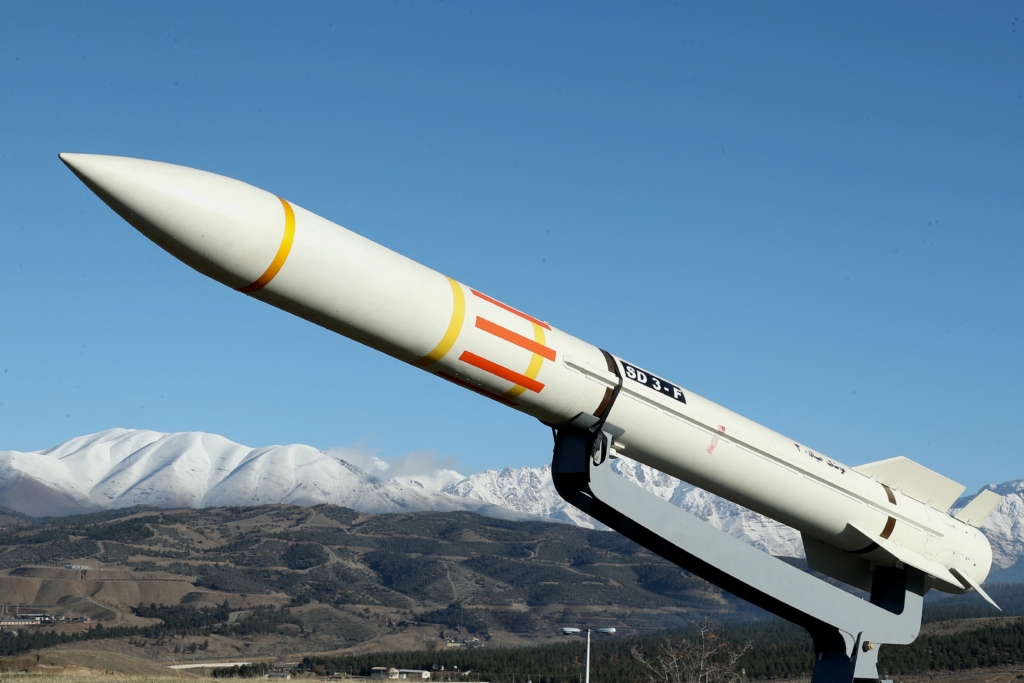
Iran’s missile program remains its core strength. Even after recent strikes, intelligence assessments suggest a significant portion of its missile arsenal remains operational, often protected in underground facilities.
| Missile Name | Type | Estimated Range | Noteworthy Feature |
| Fattah-2 | Hypersonic | 1,500 km | Reported Mach 13 speeds; maneuvering warhead. |
| Khorramshahr-4 | MRBM | 2,000 km | High-payload capacity; liquid-fueled but storable. |
| Sejjil-2 | MRBM | 2,000 km | Solid-fueled for rapid launch and mobility. |
| Kheybar Shekan | MRBM | 1,450 km | Precision-strike capability with high maneuverability. |
| Zolfaghar | SRBM | 700 km | Solid-fueled; battle-tested in regional conflicts. |

Iran military strength 2026
The December 2025 tests over major cities like Mashhad and Isfahan confirmed a shift toward improving accuracy (CEP) rather than just increasing range. Analysts estimate the current stockpile has been replenished to over 3,000 missiles, despite significant losses sustained during the mid-2025 hostilities.
Iran Military Power Capabilities 2026: Strengths vs Weaknesses
Strengths:
- Large missile arsenal
- Advanced drone warfare (Shahed series)
- Strong asymmetric strategy
Weaknesses:
- Outdated air force
- Limited training and modernization
- Heavy reliance on non-conventional tactics
Why Iran remains strategically important
Despite technological limitations, Iran’s military strategy focuses on disruption rather than dominance. Its ability to threaten shipping routes like the Strait of Hormuz and conduct drone strikes gives it disproportionate influence in the region.
Technology Comparison: Drones vs. Aircraft Jets
The most stark contrast in Iran’s military is the gap between its Air Force and its Drone Command. While the Artesh Air Force struggles with spare parts for its ~250 combat-capable jets, the IRGC has mastered the “Drone Swarm” concept.
The Aviation Gap
- Conventional Jets: Iran’s fleet relies on 50-year-old American jets and 30-year-old Russian MiG-29s. Even with rumored Su-35 deliveries from Russia, the fleet remains generations behind the F-35s operated by its regional rivals.
- Drone Supremacy: The Shahed-136 (kamikaze drone) and the newer Shahed-139 have revolutionized the region’s security. In February 2026, an F-35C was forced to intercept a Shahed-139 near the USS Abraham Lincoln, highlighting the persistent threat these low-cost systems pose to high-value assets.
The Global Perspective: Allies and the “Axis of Resistance”
Iran’s military power is not confined to its borders. The “Axis of Resistance” acts as a force multiplier. This network includes Hezbollah in Lebanon, the Houthis in Yemen, and various PMF groups in Iraq. Although the collapse of the Syrian regime in late 2024 removed a critical land bridge, the “Axis” has adapted by moving toward more autonomous, locally-produced drone and missile cells.
In early 2026, Tehran’s reliance on the Houthis has increased, as the group’s ability to disrupt Red Sea shipping provides Iran with a strategic “choke point” leverage that it lacks elsewhere. This “Unity of Fronts” ensures that any strike on Iran could trigger a multi-directional response from across the Levant and the Arabian Peninsula.
As the US and Iran engage in indirect talks in Muscat, the primary question remains: can a deal be reached that addresses the nuclear program without touching the ballistic missile “red line”? If history and current tests are any indication, Tehran views its missiles as its only true guarantee of survival in an increasingly hostile neighborhood.
Is the era of conventional air superiority ending as low-cost drone technology levels the playing field?
The Strategic Fallout: India’s Chabahar Dilemma and Energy Security
For New Delhi, Iran’s reliance on asymmetric drone warfare and its threat to the Strait of Hormuz present a severe economic vulnerability. India imports over 80% of its crude oil, with a vast majority passing through the Persian Gulf. Any activation of Iran’s “Drone Swarms” in this choke point would instantly inflate Indian fuel costs and disrupt domestic manufacturing. Furthermore, Iran’s military volatility directly threatens India’s multi-million dollar investment in the Chabahar Port New Delhi’s strategic gateway to Central Asia designed to bypass Pakistan. As Tehran increasingly relies on militant proxies to project power, India faces the diplomatic tightrope of maintaining its energy and infrastructure partnerships with Iran while shielding its economy from the fallout of IRGC escalations.
Sources:
- Global Firepower – Iran Military Strength Ranking
- Reuters – Iran missile arsenal and military capability assessment
- Axios – Iran military capabilities and ground force analysis
- BBC – Background on Iran military structure and IRGC
- CSIS (Center for Strategic and International Studies) – Iran military analysis
Frequently Asked Questions
Does Iran have hypersonic missiles in 2026?
Yes, Iran has unveiled the Fattah-1 and Fattah-2 series. While Western analysts debate the extent of their “hypersonic” maneuverability, the IRGC claims these missiles can travel at Mach 13 and bypass most current missile defense systems.
What is the role of the IRGC vs. the Regular Army?
The regular Army (Artesh) is responsible for territorial integrity and conventional defense. The IRGC is a parallel, more ideologically driven force that controls the missile program, drone operations, and regional “Axis of Resistance” coordination.
ALSO READ: India Union Budget 2026: A Blueprint for Infrastructure and Fiscal Stability
Russia China trade relations 2026: Sanctions Evasion, Dual-Use Tech, and the Putin-Xi Summit
Russia China trade relations 2026: Sanctions Evasion, Dual-Use Tech, and the Putin-Xi Summit Executive Briefing…

What is Hantavirus Outbreak 2026: Symptoms, Vaccine Status, and the Climate Vector
What is Hantavirus Outbreak 2026: Symptoms, Vaccine Status, and the Climate Vector The Immediate Trigger:…

Starlink & SpaceX IPO 2026: Everything You Need to Know
Starlink & SpaceX IPO 2026: Everything You Need to Know The Valuation: According to Institutional…
What is OPEC? How the Oil Cartel Functions and Why It’s Fracturing in 2026
What is OPEC? How the Oil Cartel Functions and Why It’s Fracturing in 2026 The…
Why the UAE Quit OPEC and the Birth of the Petro-Rupee
Why the UAE Quit OPEC and the Birth of the Petro-Rupee The Rupture: The United…

Microsoft OpenAI Partnership Ends: Why Microsoft is Dropping OpenAI’s Exclusive License
Microsoft OpenAI Partnership Ends: Why Microsoft is Dropping OpenAI’s Exclusive License The Announcement: On April…

Ibrahim is the Founder and Lead Analyst at The Global Angle, an independent digital platform dedicated to factual geopolitical analysis and international affairs. Based in India, he combines an engineering background with a deep focus on global markets, diplomacy, and strategic security. Ibrahim leverages a data-driven, analytical approach to break down complex international conflicts and economic shifts, helping readers see beyond standard news narratives. When he isn’t researching global policy, he focuses on digital publishing, search engine optimization, and platform architecture.