Russian vs Venezuelan Crude Oil: Comparing Oil Quality and Prices for India
- India is pivoting from Russian Urals to Venezuelan Merey crude as part of a 2026 strategic trade de-escalation with the United States.
- Venezuelan Merey is significantly heavier and more “sour” than Russian Urals, requiring complex refining capabilities found primarily in private Indian facilities.
- While Russian oil offered deep $10–$20 discounts, the shift to Venezuela could increase India’s import bill by up to $9 billion annually due to higher freight and lower yields.
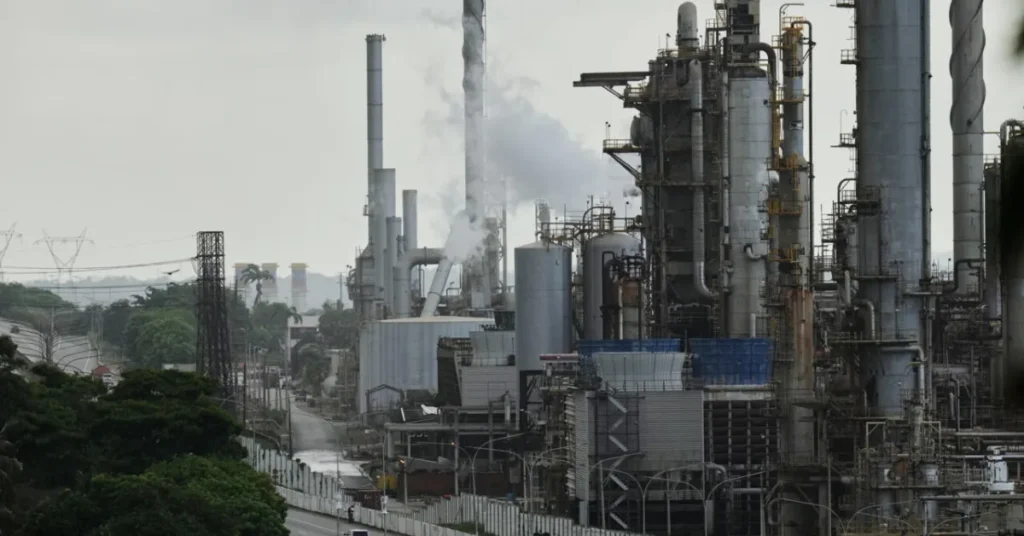
India’s crude oil strategy is no longer just about supply it is about balancing cost, geopolitics, and refinery compatibility. While Russian oil has dominated imports due to steep discounts, Venezuela is emerging as a potential alternative as India diversifies its energy sources.
The real question is not which oil is better, but which one makes more economic and strategic sense for Indian refiners.
Russian Urals crude has been trading at discounts of around $10 per barrel compared to global benchmarks, making it highly attractive for Indian refiners.
India has also recently imported Venezuelan Merey crude, with state refiners purchasing around 2 million barrels as part of diversification efforts.
Quality and Technical Comparison: Russian vs Venezuelan Crude Oil
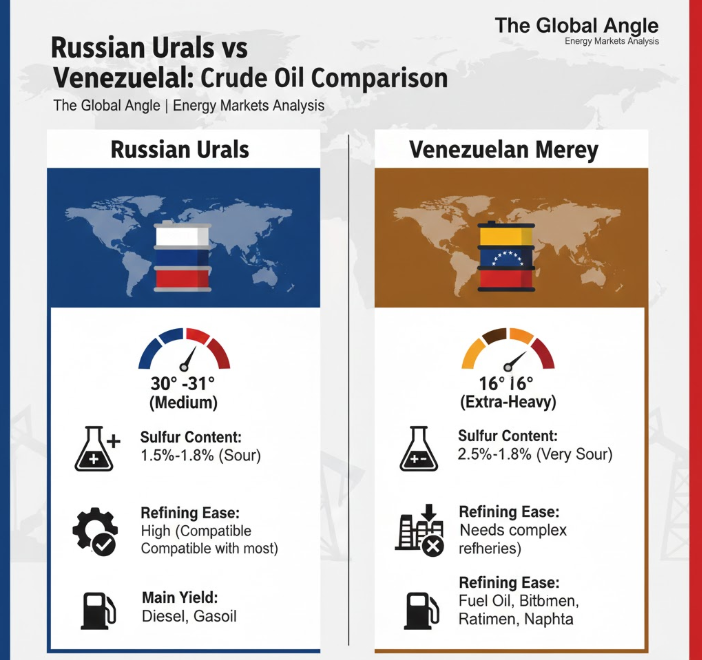
The most critical difference between these two sources lies in their chemical DNA. Crude oil is categorized by its density (API Gravity) and its sulfur content.
- Russian Urals: Classified as a medium-heavy, sour blend. It is relatively easy to process for most Indian Public Sector Undertaking (PSU) refineries. It provides a balanced yield of diesel and petrol.
- Venezuelan Merey: Classified as extra-heavy and highly sour. It is thick, viscous, and has been compared to molasses. Processing Merey requires advanced “secondary” refining units—specifically coking and hydro-processing—to break down the heavy molecules into usable fuel.
| Specification | Russian Urals (Approx.) | Venezuelan Merey (Approx.) |
| API Gravity | 30° – 31° (Medium) | 16° (Extra-Heavy) |
| Sulfur Content | 1.5% – 1.8% (Sour) | 2.5% – 3.8% (Very Sour) |
| Refining Ease | High (Compatible with most) | Low (Needs complex refineries) |
| Main Yield | Diesel, Gasoil | Fuel Oil, Bitumen, Naphtha |
The Price of Diversification: Discounts and Freight
Historically, India became the world’s largest buyer of Russian sea-borne crude because of the “war discount,” which often ranged between $10 and $20 per barrel below Brent. In contrast, Venezuelan Merey currently offers a narrower discount of roughly $5–$12 per barrel.
Logistics further complicate the math. A tanker from Russia’s Baltic ports takes approximately 25–30 days to reach India. A shipment from Venezuela takes 45–50 days, nearly doubling the freight and insurance costs. Analysts estimate that substituting Russian barrels with Venezuelan oil could cost India an additional $6–$8 per barrel on a “delivered basis,” potentially inflating the national import bill by $11 billion.
Processing Power: Reliance vs. PSU Refineries
The ability to benefit from Venezuelan oil is not distributed equally across India. Private players like Reliance Industries and Nayara Energy operate some of the most complex refineries in the world in Jamnagar and Vadinar. These facilities are specifically designed to “bottom of the barrel” process the heaviest crudes into high-value exports.
In February 2026, Reliance secured its first 2-million-barrel cargo of Venezuelan oil in months, following the U.S. “green-lighting” of specific trade licenses. PSUs like Indian Oil Corporation (IOC) and HPCL are also venturing back into the Venezuelan market, with a recent joint purchase of 2 million barrels for delivery to the Paradip and Visakhapatnam units. However, for older PSU refineries, Venezuelan oil must be blended with lighter, more expensive crudes to avoid damaging the equipment.
Why Russian still Dominates
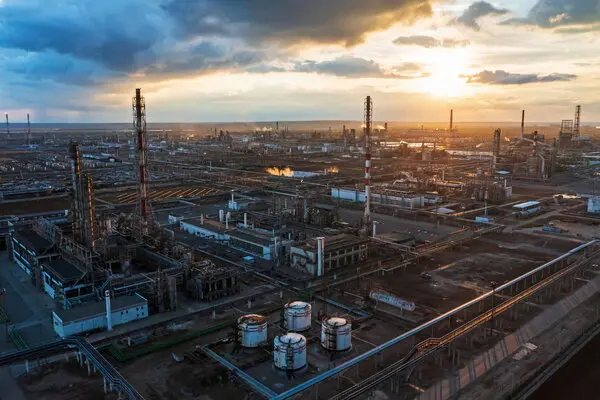
Despite diversification efforts, Russian crude remains the preferred choice for India due to its deep discounts, stable supply routes, and compatibility with existing refinery configurations.
Switching fully to Venezuelan oil would increase shipping costs and processing complexity, limiting its viability as a primary source.
Why India is Exploring Venezuelan Crude Oil
India is not replacing Russian oil but reducing dependency. Geopolitical pressure, sanctions, and trade negotiations are pushing India to diversify its crude supply sources to ensure long-term energy security.
Current Scenario and Future Prospect
As of mid-February 2026, India is walking a diplomatic tightrope. While the government has not officially committed to a “zero-Russia” policy, the trajectory is clear. The U.S. has pitched Venezuelan crude as a “politically acceptable” alternative that helps India maintain its energy security while distancing itself from Moscow’s war chest.
Future Outlook (2026–2030):
- Investment in Venezuela: Indian PSUs (like OVL) may look to revive their $1 billion in “stuck” dividends by investing in Venezuelan upstream projects to stabilize production.
- Infrastructure Upgrades: Expect a wave of brownfield investments in Indian PSU refineries to increase their “complexity factor,” allowing them to handle heavier Atlantic Basin crudes.
- The Middle East Renaissance: If Venezuelan production remains capped at its current ~1 million bpd, India will likely return to its traditional Gulf partners (Iraq, Saudi Arabia) to fill the massive gap left by Russian barrels.
The era of easy, deeply-discounted Russian oil is fading. India’s energy future now depends on its ability to refine the “world’s heaviest oil” while navigating the most complex geopolitical landscape of the decade.
Will India’s private refiners emerge as the primary beneficiaries of this shift, or will the rising import bill force a rethink of the “Strategic Surrender” to Western trade demands?
What determines India’s choice
India’s decision is driven by three factors:
- Price (discount vs landed cost)
- Refinery compatibility
- Supply reliability
On all three metrics, Russian crude currently holds an advantage, while Venezuelan oil remains a secondary option.
Sources:
- Reuters – Russian Urals crude discounts and India imports
- Investing.com – India purchases Venezuelan Merey crude (2 million barrels)
- S&P Global – India open to Venezuelan crude on commercial basis
- Al Jazeera – Can India switch from Russian to Venezuelan oil?
- Carpe Diem IAS – Why Venezuelan crude is difficult to refine
Frequently Asked Questions
Is Venezuelan oil cheaper than Russian oil?
Generally, no. While both are discounted, the Russian “Urals” discount has historically been deeper. Additionally, the much longer shipping distance from Venezuela significantly increases the final “landed” price in India.
Can all Indian refineries process Venezuelan Merey?
No. Only “complex” refineries with high Nelson Complexity Indices like those owned by Reliance and Nayara can efficiently process extra-heavy Venezuelan crude. Most older PSU refineries can only handle it in small, blended quantities.
ALSO READ: The American Referendum: Understanding U.S. Midterm Elections and How They Work
ALSO READ: The Architecture of Deterrence: Analyzing Iran Military Power 2026
Russia China trade relations 2026: Sanctions Evasion, Dual-Use Tech, and the Putin-Xi Summit
Russia China trade relations 2026: Sanctions Evasion, Dual-Use Tech, and the Putin-Xi Summit Executive Briefing…
What is Hantavirus Outbreak 2026: Symptoms, Vaccine Status, and the Climate Vector
What is Hantavirus Outbreak 2026: Symptoms, Vaccine Status, and the Climate Vector The Immediate Trigger:…
Starlink & SpaceX IPO 2026: Everything You Need to Know
Starlink & SpaceX IPO 2026: Everything You Need to Know The Valuation: According to Institutional…
What is OPEC? How the Oil Cartel Functions and Why It’s Fracturing in 2026
What is OPEC? How the Oil Cartel Functions and Why It’s Fracturing in 2026 The…
Why the UAE Quit OPEC and the Birth of the Petro-Rupee
Why the UAE Quit OPEC and the Birth of the Petro-Rupee The Rupture: The United…

Microsoft OpenAI Partnership Ends: Why Microsoft is Dropping OpenAI’s Exclusive License
Microsoft OpenAI Partnership Ends: Why Microsoft is Dropping OpenAI’s Exclusive License The Announcement: On April…

Ibrahim is the Founder and Lead Analyst at The Global Angle, an independent digital platform dedicated to factual geopolitical analysis and international affairs. Based in India, he combines an engineering background with a deep focus on global markets, diplomacy, and strategic security. Ibrahim leverages a data-driven, analytical approach to break down complex international conflicts and economic shifts, helping readers see beyond standard news narratives. When he isn’t researching global policy, he focuses on digital publishing, search engine optimization, and platform architecture.