US-Europe Diplomatic Divide 2026: How U.S. & Europe are Falling Apart
- The Security Disconnect: Washington defines global security through hard military dominance and containment. Brussels defines security through supply chain stability, energy access, and diplomatic de-escalation.
- The 2026 Flashpoints: Three massive crises the grinding Ukraine stalemate, the U.S.-Iran conflict, and the aggressive U.S. bid to acquire Greenland have exposed the alliance as fundamentally misaligned.
- The European Pivot: European nations are shifting from U.S. dependents to strategic hedgers. France is accelerating “Strategic Autonomy,” Poland is building Europe’s largest land army, and the EU is aggressively signing independent trade deals to bypass American protectionism.
The transatlantic alliance is structurally fracturing. Over the past 24 months, the diplomatic bridge connecting Washington and Brussels has buckled under the weight of competing geopolitical realities.

For seven decades, the United States and Europe operated on a shared diplomatic operating system. Today, that system is incompatible. Washington’s aggressive, “America First” posture directly threatens the economic survival of the European continent.
To understand the severity of this collapse, you must look past the press conferences. Here is the data-driven analysis of the specific policy collisions driving Europe away from the United States, and how individual capitals are actively redesigning their foreign policy.
The Three Pillars of the 2026 Diplomatic Collapse
The diplomatic rupture is not based on ideological differences. It is based on raw economics and physical geography. What Washington views as a distant strategic maneuver, Europe experiences as an immediate domestic crisis.
The divergence is currently localized across three distinct geopolitical flashpoints.
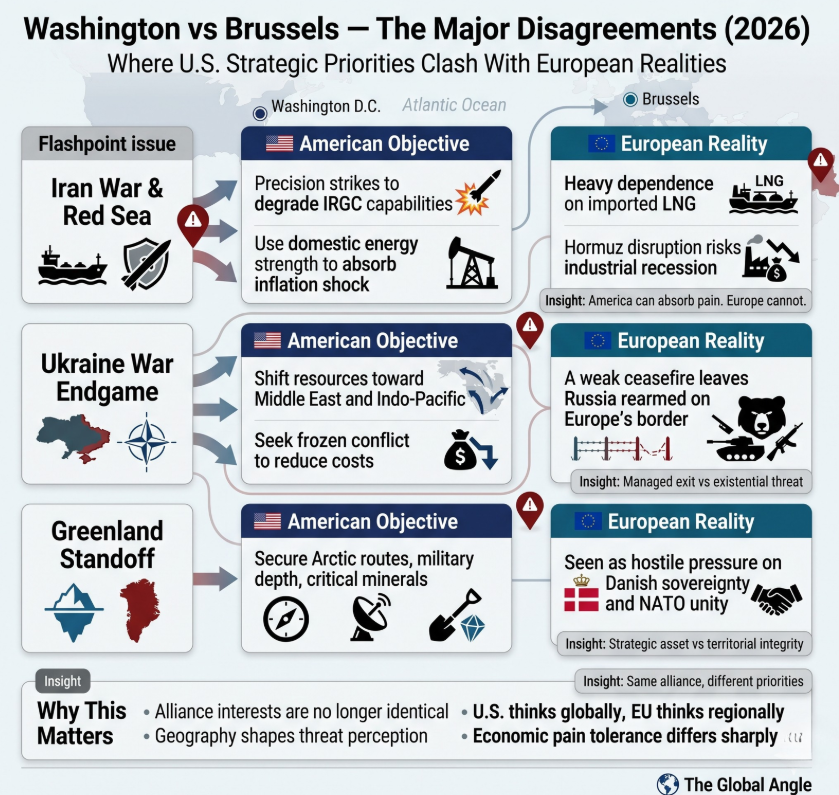
The Major Disagreements (Washington vs. Brussels)
| The Flashpoint | The American Objective | The European Reality |
| The Iran War & The Red Sea | Execute precision strikes to degrade IRGC capabilities. Absorb inflation through domestic energy independence. | Catastrophic Vulnerability: Europe relies heavily on imported LNG. The Strait of Hormuz blockade threatens to push the EU industrial sector into a deep recession. |
| The Ukraine War Endgame | Pivot defense resources to the Middle East and Indo-Pacific. Push for a rapid, frozen-conflict ceasefire to limit financial drain. | Existential Threat: A forced, unfavorable ceasefire leaves an emboldened, fully mobilized Russian military directly on the borders of the EU and NATO. |
| The Greenland Standoff | Acquire the semi-autonomous territory to secure Arctic dominance and a monopoly on critical minerals. | Sovereignty Assault: Viewed as a hostile, imperial land grab against a NATO ally (Denmark), fundamentally violating European territorial integrity. |
The Asymmetry of Risk
The core driver of the collapse is the asymmetry of risk. When the U.S. initiates a trade war with China or a kinetic war with Iran, the Pacific and Atlantic oceans act as massive geographic buffers. The U.S. economy is highly insulated by domestic energy production (shale oil and gas) and a massive internal consumer market.
Europe possesses no such buffers. A U.S. strike in the Middle East immediately spikes natural gas prices in Berlin. A U.S. demand to decouple from Chinese technology immediately threatens automotive exports in Paris. Europe absorbs the economic blast radius of American foreign policy.
What Each European State Has to Say
The European Union is not a monolith. The frustration with Washington manifests differently across the continent. Western Europe seeks independence, while Eastern Europe seeks insurance.
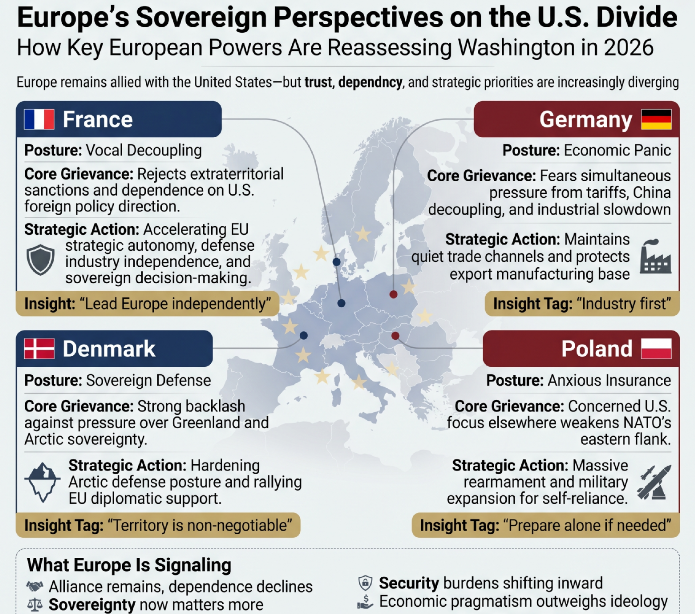
Sovereign Perspectives on the U.S. Divide
| Nation | Diplomatic Posture | Core Grievance with Washington | Strategic Action Taken |
| France | Vocal Decoupling | Rejects U.S. extraterritorial sanctions and demands Europe stop acting as a “vassal” to American foreign policy. | President Macron is aggressively accelerating “Strategic Autonomy,” pushing for a unified EU defense industry entirely independent of U.S. supply chains. |
| Germany | Economic Panic | Terrified of the U.S. instigating a two-front trade war (tariffs on European cars while simultaneously demanding the EU embargo China). | Quietly maintaining backchannel trade ties with Beijing to protect its heavy manufacturing sector from collapse. |
| Denmark | Sovereign Defense | Outraged by President Trump’s aggressive diplomatic pressure to acquire or annex Greenland. | Prime Minister Mette Frederiksen has hardened Arctic defense protocols and rallied EU leaders to explicitly condemn U.S. territorial ambitions. |
| Poland | Anxious Insurance | Fears the U.S. is too distracted by the Middle East to defend NATO’s eastern flank against Russia. | Executing the most massive rearmament in modern European history, aiming to build a 300,000-strong army to guarantee its own security without relying solely on the Pentagon. |
How Europe is Actively Moving Away
The shift is no longer theoretical. European capitals are executing hard policy changes to bypass American influence.
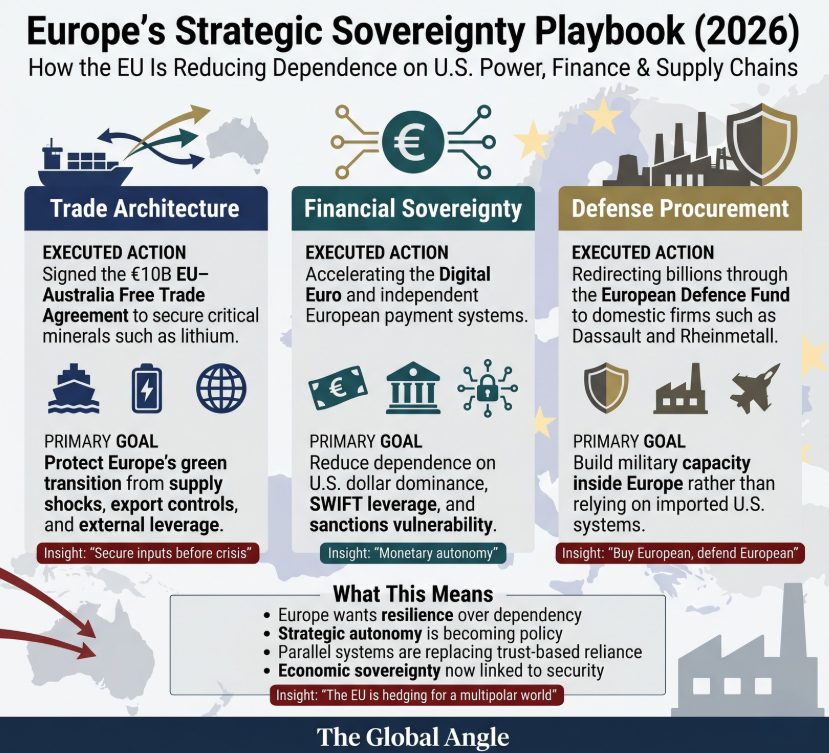
1. Independent Trade Architecture
Following the breakdown of U.S. trade norms, the EU is building its own economic architecture. The recent $10 billion EU-Australia Free Trade Agreement explicitly bypasses American protectionism. By securing its own critical mineral supply chains (like Australian lithium), the EU is insulating its green energy transition from Washington’s export controls.
2. The De-Dollarization Hedge
While the U.S. dollar remains dominant, the EU is actively laying the groundwork to bypass U.S. financial hegemony. The European Central Bank is accelerating the digital Euro project. The goal is to create an alternative financial clearing system that cannot be instantly crippled if a future U.S. administration decides to arbitrarily wield SWIFT sanctions against European companies.
3. Fragmented Defense Procurement
For decades, NATO interoperability meant buying American weapons. Today, the European Defence Fund (EDF) is funneling billions of euros specifically into domestic defense contractors (like Dassault and Rheinmetall). The directive is clear: European tax dollars must build European weapons.
| Strategic Sector | Executed Policy Action | Primary Geopolitical Goal |
| Trade Architecture | Signing the $10 billion EU-Australia Free Trade Agreement to secure critical minerals (e.g., lithium). | Insulate the European green energy transition from U.S. protectionism and export controls. |
| Financial Sovereignty | Accelerating the European Central Bank’s “digital Euro” development. | Establish an alternative clearing system to bypass U.S. dollar hegemony and potential SWIFT sanctions. |
| Defense Procurement | Redirecting billions through the European Defence Fund (EDF) to domestic contractors like Dassault and Rheinmetall. | Phase out reliance on American weapons systems to ensure European tax revenue builds European military capacity. |
The Strategic Endgame
The U.S. and Europe are not enemies, but they are no longer aligned partners. They are transitioning into transactional allies.
Washington expects compliance in exchange for the NATO security umbrella. Europe, exhausted by the volatility of U.S. domestic politics and the economic fallout of American wars, is rapidly building the infrastructure to say no.
Sources:
European Council on Foreign Relations (ECFR) – Transatlantic Relations Tracker (Comprehensive polling and policy data on European public sentiment toward U.S. foreign policy and the push for “Strategic Autonomy”)
Stockholm International Peace Research Institute (SIPRI) – Military Expenditure Database (Primary data source tracking Poland’s massive historic defense budget increases and the shift in European domestic arms procurement)
European Central Bank (ECB) – The Digital Euro Project (Official documentation on the EU’s development of a sovereign digital currency clearing system independent of the U.S. Dollar)
European Commission: Directorate-General for Trade (Official policy texts and economic impact assessments of the EU-Australia Free Trade Agreement and critical mineral supply chains)
NATO – Defence Expenditure of NATO Countries (2014-2026) (Official alliance data detailing the defense spending gaps between the United States and European member states)
Frequently Asked Questions
Why are European countries angry about the U.S. war with Iran?
The U.S.-Iran conflict has effectively closed the Strait of Hormuz. Because the U.S. produces its own energy, it avoids the worst of the crisis. Europe, however, relies heavily on imported Liquefied Natural Gas (LNG) from the Gulf. The U.S. military action has inadvertently spiked European energy costs, threatening a deep industrial recession.
What happened between the U.S. and Denmark over Greenland?
The U.S. administration aggressively attempted to acquire the semi-autonomous territory of Greenland to secure critical minerals and Arctic military dominance. Denmark and the broader European Union firmly rejected the advance, viewing it as an unacceptable assault on European territorial sovereignty.
What does “Strategic Autonomy” mean for Europe?
Championed primarily by France, Strategic Autonomy is the policy goal of making the European Union entirely self-sufficient in defense, technology, and energy. It is a direct response to the unreliability of U.S. foreign policy, aiming to allow Europe to act globally without relying on American permission or resources.
ALSO READ: Strait of Hormuz Current Status: Comparing U.S vs Iranian Narrative What Each Side Has to Say?
Russia China trade relations 2026: Sanctions Evasion, Dual-Use Tech, and the Putin-Xi Summit
Russia China trade relations 2026: Sanctions Evasion, Dual-Use Tech, and the Putin-Xi Summit Executive Briefing…

What is Hantavirus Outbreak 2026: Symptoms, Vaccine Status, and the Climate Vector
What is Hantavirus Outbreak 2026: Symptoms, Vaccine Status, and the Climate Vector The Immediate Trigger:…
Starlink & SpaceX IPO 2026: Everything You Need to Know
Starlink & SpaceX IPO 2026: Everything You Need to Know The Valuation: According to Institutional…
What is OPEC? How the Oil Cartel Functions and Why It’s Fracturing in 2026
What is OPEC? How the Oil Cartel Functions and Why It’s Fracturing in 2026 The…
Why the UAE Quit OPEC and the Birth of the Petro-Rupee
Why the UAE Quit OPEC and the Birth of the Petro-Rupee The Rupture: The United…

Microsoft OpenAI Partnership Ends: Why Microsoft is Dropping OpenAI’s Exclusive License
Microsoft OpenAI Partnership Ends: Why Microsoft is Dropping OpenAI’s Exclusive License The Announcement: On April…

Ibrahim is the Founder and Lead Analyst at The Global Angle, an independent digital platform dedicated to factual geopolitical analysis and international affairs. Based in India, he combines an engineering background with a deep focus on global markets, diplomacy, and strategic security. Ibrahim leverages a data-driven, analytical approach to break down complex international conflicts and economic shifts, helping readers see beyond standard news narratives. When he isn’t researching global policy, he focuses on digital publishing, search engine optimization, and platform architecture.